Technical SEO

Technical SEO tools, wired into the work you already do.

Indexing, structured data, crawlability, infrastructure. Not a separate audit you run once a quarter and forget — checks that fire where the work happens, and that run free on every plan.

Technical SEO isn’t a tab. It’s the plumbing.

Most platforms sell technical SEO as a button: run the crawl, get a list of four hundred issues sorted by a severity score nobody agreed on, export the PDF, close the tab. The list is accurate and nothing happens, because the findings arrive nowhere near the moment you could act on them.

AlmaSEO doesn’t have a single Technical SEO product, and it isn’t going to pretend otherwise. What it has is technical checks built into the tools you already open — the schema is generated when the article is written, the URL is submitted the second it publishes, the SSL expiry shows up on the same page as the hosting renewal, and the Core Web Vitals reading lands inside the audit that explains what to do about it.

Two of those checks carry the most weight: the technical audit, which reads performance, schema and AI-crawler access on the pages actually earning your clicks — and keeps re-reading Core Web Vitals across every client site on a schedule, flagging the ones that slipped; and index status, which shows you which of your pages Google has actually indexed and lets you resubmit the ones it hasn’t — to Google, Bing and IndexNow at once. The rest of the map is below.

For the owner buried in a scan report — and the agency running the crawl.

For the small business owner

You were told your site has "technical issues."

Someone ran a scan, sent you a spreadsheet with four hundred rows, and asked for a budget. You have no way to tell which rows matter, which are noise, and which were already fixed. What you want is a short answer: is my site broken, and if so, where.

  • One health reading instead of four hundred rows
  • Renewal dates for the domain, host and SSL in one place
  • Plain language about what’s actually costing you traffic
For the SEO freelancer or agency

You’re the one running the crawl.

You know what a canonical is. What you don’t have is the hour it takes to check schema coverage on twelve client sites, confirm every published URL got submitted, and notice that one of them let their SSL lapse on a Sunday.

  • Submission to Google and Bing on publish, not on a checklist
  • Schema generated and validated as content ships
  • SSL and expiry monitoring across the whole book

Four engines, and every check inside them.

Not one is a separate product you have to remember to open — each check fires inside a tool you’re already using.

Indexing and submission

Getting the page seen, and knowing when it isn't.

Per-URL index status

Inspect any URL against Google — is it indexed, what’s the coverage state, when was it last crawled, which canonical did Google pick — and a nightly scan reads it across your whole sitemap.

Auto IndexNow on publish

The moment WordPress publishes a URL, it’s submitted. No button to remember.

Resubmit to Google and Bing

A page Google hasn’t indexed? Request indexing on the spot — to Google, Bing, and IndexNow.

Powered bySearch Console coverageSitemap statusIndexNow submissionBing URL submission

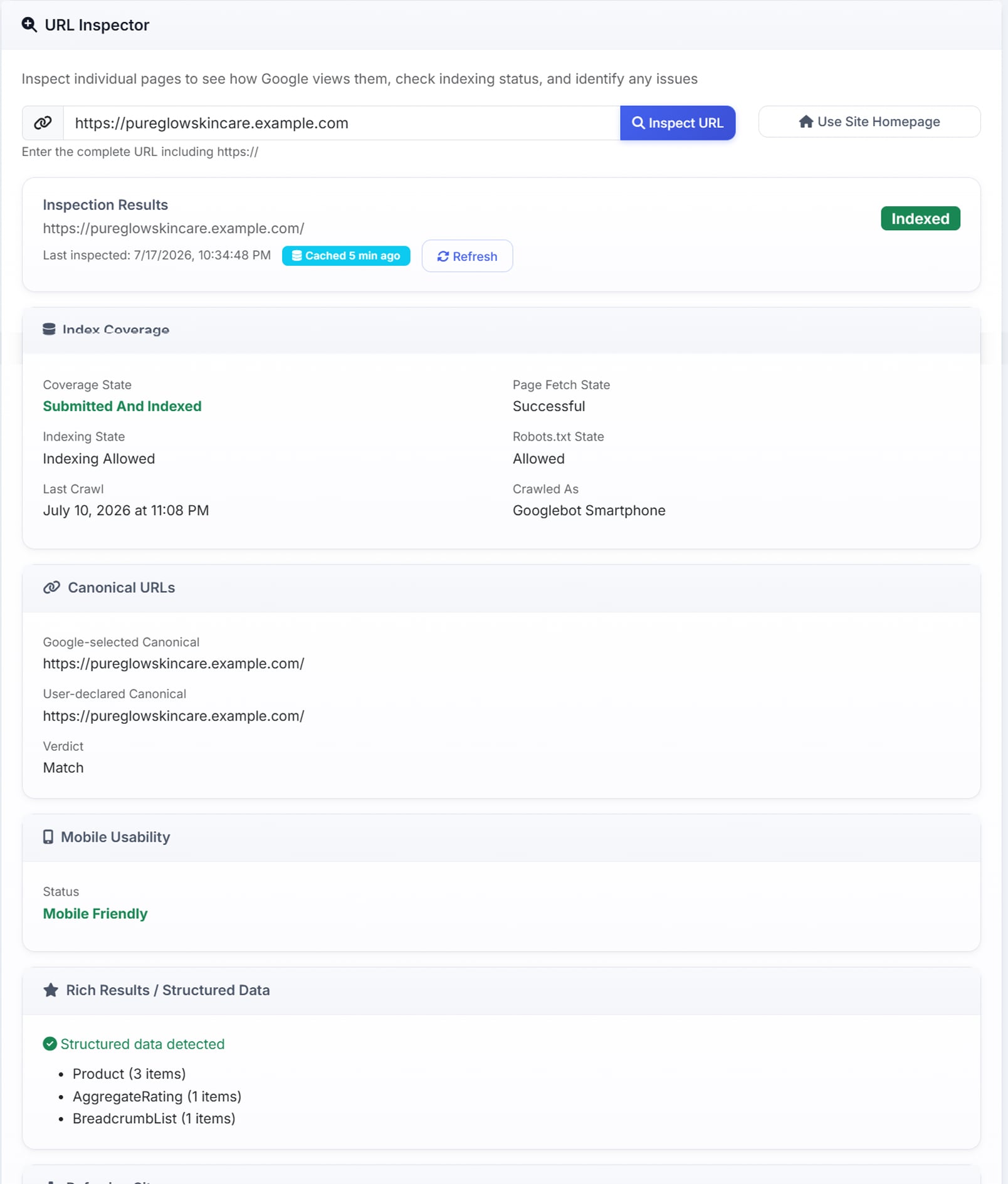
The URL Inspector: a page inspected against Google and reported Indexed — coverage state 'Submitted and indexed,' indexing allowed, robots.txt allowed, last crawl date and crawled-as Googlebot Smartphone; the Google-selected and user-declared canonicals matching; a mobile-friendly status; and the rich-result structured data detected on the page
Inspect any URL against Google — indexed or not, the canonical it picked, the rich results it sees.

Structured data and metadata

Telling the engines — and the AI answers — what the page is.

Schema, generated and validated

JSON-LD built and checked as content ships, and carried into the article AlmaSEO publishes — not bolted on afterwards.

Schema generator

Hand-built blocks: Article, FAQPage, HowTo, BreadcrumbList, Service and Organization.

SEO metadata

Title, description, focus keywords, Open Graph, canonical and slug — synced to your SEO plugin.

Powered bySchema detection and scoringStatic export schemaStructured data dashboardSEO metadata panelCustom permalink

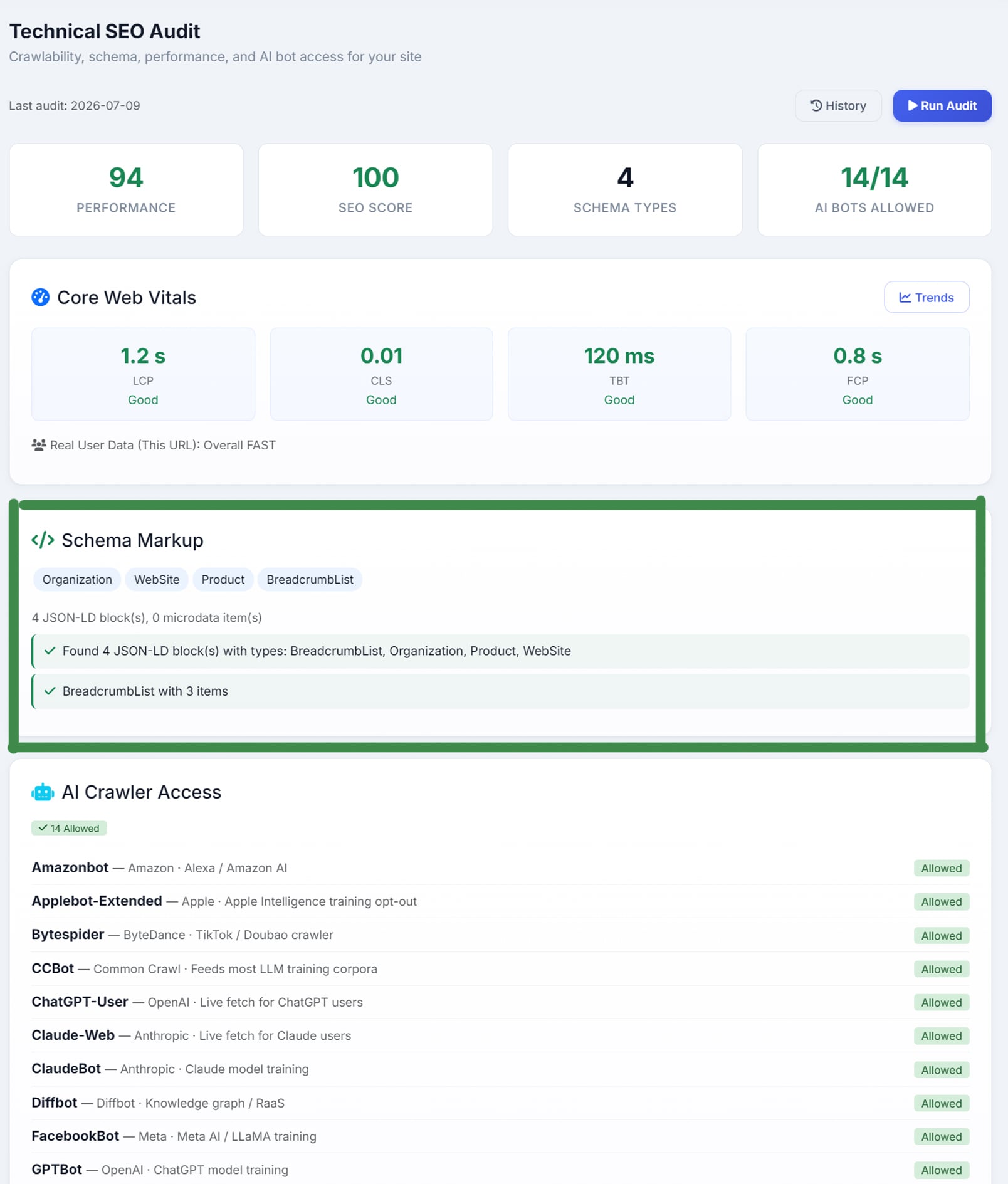
The Technical SEO Audit: a performance score of 94, an SEO score of 100, four schema types found and every AI crawler allowed across the top; Core Web Vitals all rated good with real-user data marked fast; a highlighted Schema Markup panel listing the JSON-LD types found — Organization, WebSite, Product and BreadcrumbList; and an AI Crawler Access list showing each major AI bot allowed
Schema detected and validated inside the technical audit — every type found, every block counted.

Crawlability and site architecture

Whether the shape of the site makes sense to a crawler.

Sitemap and scrape discovery

Reads sitemap.xml, falls back to scraping the HTML, and finds every published URL — even on a site with no CMS.

Content gap detection

Flags the services and topics you should have a page for but don’t, before anyone tells you to just write more posts.

Semantic duplicate detection

Finds pages competing on the same topic or intent, so you stop cannibalizing yourself.

Powered byStatic site inventoryContent gapsContent extraction

Infrastructure and delivery

The layer beneath SEO, where the outages actually come from.

Infrastructure scan

Hosting, DNS, security headers, response time and an overall health score — rescanned on its own every day, saved as an audit you can hand over.

SSL and security

Certificate issuer, covered domains, validity and days remaining, protocol and cipher — plus the security-header check.

Expiry alerts

SSL expiry is detected and emails you before it lapses; add your domain and hosting renewal dates alongside so nothing sneaks up on a Sunday.

Powered byScan overviewDomain and DNSHostingEmail providers

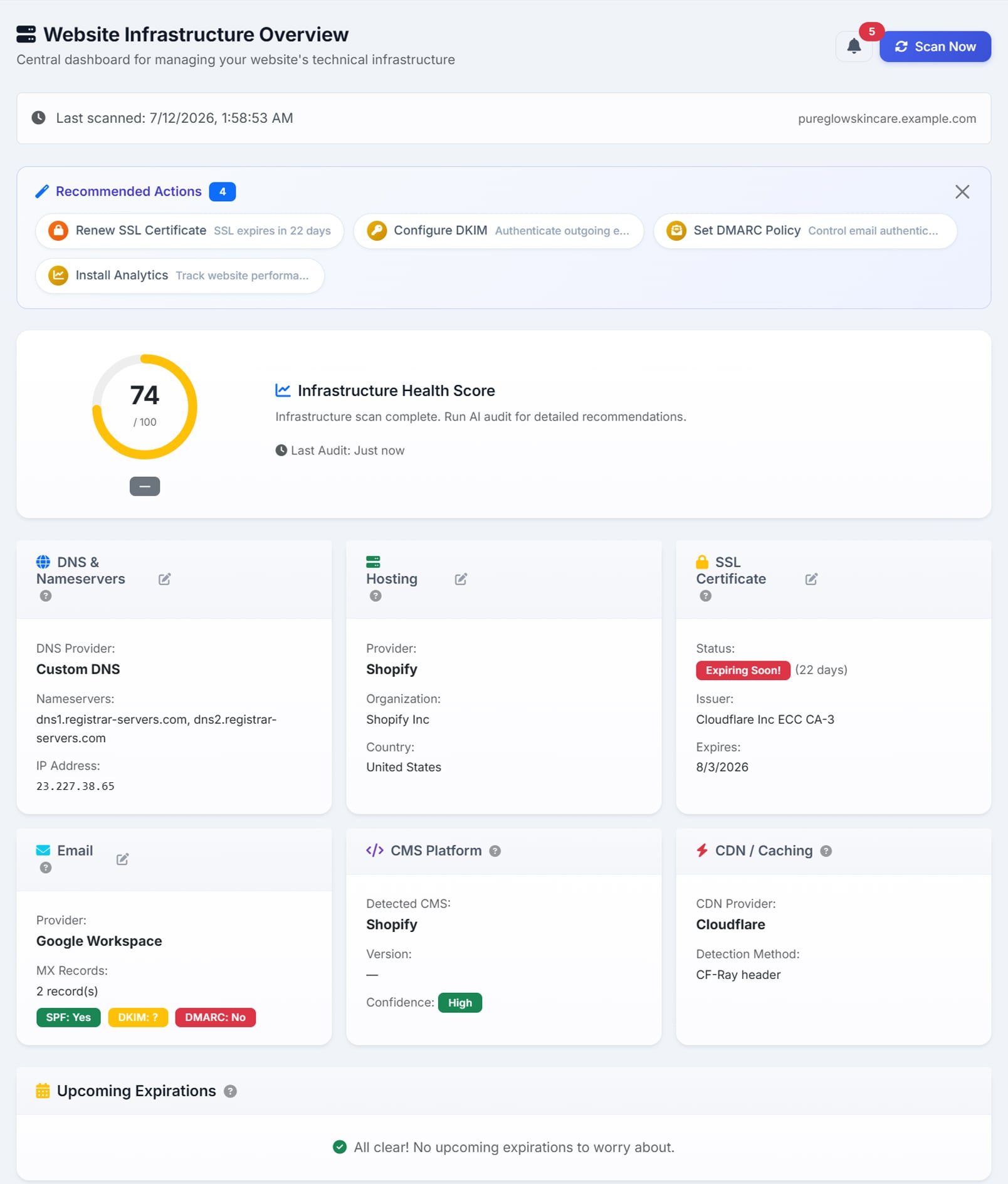
The Website Infrastructure Overview: an infrastructure health score of 74 with recommended actions including renewing an SSL certificate that expires in 22 days; cards for DNS and nameservers, Shopify hosting, an SSL certificate flagged expiring soon, email on Google Workspace with SPF passing but DKIM and DMARC still to configure, a detected Shopify CMS, and Cloudflare as the CDN — above an upcoming-expirations panel
Hosting, DNS, SSL and expiry dates — the layer that takes a site down, watched for you.

Diagnosis and monitoring

What runs continuously, and what runs when something breaks.

Website Analysis

First impression, AI search readiness and emergency recovery, resolved into one prioritized list of fixes.

SEO Recovery Review

Search Console, NAP, page speed, Core Web Vitals, schema, robots.txt, SERP movement and Analytics — one emergency pass. See the SEO recovery audit.

Core Web Vitals monitor

Every connected site’s Core Web Vitals re-checked on a schedule, so you hear about it the moment a page’s loading speed crosses the line — before the ranking follows.

Powered byAI Search ReadinessFirst ImpressionContent performance trackerSearch visibility opportunities

All of it runs on Google’s own free performance and index data — no Data Credits, on every plan. The audit reads a page in about a minute; the infrastructure scan and the index check run themselves on a schedule.

See the technical checks running.

Point the audit at a site and watch it read speed, Core Web Vitals, schema and crawler access in one pass — then check which pages Google has actually indexed.